Follow GuyMacPherson on Twitter

Monday, January 30, 2012

Margaret Cho interview


MARGARET CHO
January 10, 2012

"I’m definitely a stand-up comic. That’s what I’ll always be. Everything else is wonderful and part of it, but I identify as a stand-up comedian. That’s where I come from. But it’s also where my joy comes from." – Margaret Cho

Guy MacPherson: Hi Margaret, how are you?
Margaret Cho: Hi. Good, how are you?

GM: It’s been a while. We’ve spoken twice before. Seems like every five or six years we talk. Just looking over your career again and it’s really quite remarkable. You should be sixty years old by now.
MC: (laughs) I should be. I feel it. (laughs) I’m not yet.

GM: Oh, I know! But when you think of what you’ve done and who you’ve worked with: Arsenio Hall, Bob Hope, opening for Seinfeld, and all the turns your career has taken. And you’re still relatively young.
MC: Yeah, I’m 43 so, you know, that’s not too bad, I think.

GM: I first saw you at Bumbershoot. You were replacing Jon Stewart. Do you remember this?
MC: Oh! Um, I’m sure it’s true, yes. I used to open for him, too, a long time ago so that sounds familiar. Yeah, was that the year it was like David Cross and Tenacious D?

GM: Yes, that’s right.
MC: Yeah, that was great.

GM: Do you know when that was?
MC: Uh, it may have been like ’96. Maybe ’97. Something like that.

GM: That was that whole alt scene you were a part of, right?
MC: Right.

GM: And then you shot past them.
MC: (chuckles) We all kind of did our own thing. We all changed. Our lives, you know, comics really change and they really become a different thing. You start out hanging out with each other and then everybody grows up and does their own stuff. It’s sort of interesting to look back and see who does what and what people are known for. Yeah, I was very lucky and [have] friends I love in comedy. But that was a fun time. I really love David and I love Jack Black. And Laura Kightlinger was there that year.

GM: That’s right!
MC: It was really fun.

GM: You’re coming to Vancouver to the festival in February and so are David Cross and Bob Odenkirk as well.
MC: Oh, that’s great.

GM: It’ll be like old home week for you.
MC: Yeah, yeah. I love those guys. I haven’t seen either of them for a long time. I get to see them on TV and movies. I was just talking about David and how great he was in the Bob Dylan movie, I’m Not Here as Alan Ginsberg. I always thought he was so genius and funny. And I love his acting.

GM: Who?
MC: David Cross.

GM: Okay. And of course in the Chipmunks movies. Fantastic.
MC: Uh-huh.

GM: They still play the alternative rooms down in L.A. Do you ever? Or are you too big for that?
MC: I totally do. I’ll do anything. I don’t have any kind of idea of where is good. I just do whatever I can. I perform in book stores and comedy clubs and theatres and concert halls. And to me it’s kind of all the same thing because I just love what I do. I try to do as much as I can.

GM: You started out in stand-up then branched out to acting, writing, music. Do you call what you do now stand-up or is it just performance?
MC: Yeah, yeah I’m definitely a stand-up comic. That’s what I’ll always be. And that’s the work I do that really is what defines me and everything else is wonderful and part of it, but I identify as a stand-up comedian. That’s where I come from and where my livelihood comes from most of the time. But it’s also where my joy comes from. All the writing that I do or the journalism that I do or the music that I do is still comedy to me. So it’s all the same kind of job.

GM: You’ve done six live concert films, right?
MC: Yes.

GM: All the talk these days is  about Louis CK and how frequently he turns over material. Every year he does a new hour. How frequently do you change your act?
MC: (warbled) I think it’s really important to. I do new material every time I do a big tour every year. So at least an hour a year, if not more. I think comics of my generation – and Louis is exactly that – we take a lot of pride in the writing and being prolific. And also entertaining ourselves when we’re doing it. But he’s a great inspiration to me. I’m a real fan of his.

GM: Is it hard? Is it a grind coming up with new stuff or does it come easy to you?
MC: Oh, no, no, it’s not a grind. It’s very easy. It’s more like I have to to make it interesting for yourself. I would find it really unbearable to have the same material all the time. By nature I am a writer so that kind of writerly thing in me is always trying to push forward and do something new. I take great joy in writing and continuing to grow.

GM: Otherwise it just becomes rote and maybe you wouldn’t give the same performance?
MC: Yeah. And I would be bored. We’re like painters or musicians. Well, musicians actually have it hard because they eventually have to do the same things all the time because you get a fan base and they want to hear the same thing. But with comedy, the fact is you have to constantly create new material to keep your fans. It’s a way of communicating with your fans and it’s sort of the opposite of music. They don’t want to see you do the same thing; they want to see something different.

GM: Yeah, “play the hits.”
MC: Yeah, that’s what people prefer from musicians but as comedians we’re very lucky in that we can rewrite it all. Every day it’s new and I’m very grateful for that.

GM: Is your show here part of a big tour?
MC: No, no. I’m actually just finished with a lot of touring this past year and then after I go to Vancouver I’ll go to Atlanta, where I work on Drop Dead Diva. I’ll be there for six months and then after that I’ll continue more touring but I always have to take a break around February/March until about August to do the show.

GM: Is it like riding a bike when you get back or does it take a little while to get your chops back?
MC: Well, I never stop because I’m constantly doing shows at venues in Georgia. I do a lot of stuff at the Laughing Skull. I’ll do a lot of stuff everywhere, like Star Bar. Anything I can get to I really want to get to so I never stop. There’s never any kind of interruption in me as a stand-up comic. To me, it’s also my social life and everything that I am attracted to as a human being. All my friends are comics so that’s a natural environment for me.

GM: So does the show you’re doing here have a name like many of yours do?
MC: This one doesn’t have a name so maybe we can make one up! (laughs)

GM: Hey, let’s do that!
MC: I don’t know, the last name was so good. I don’t have a good pun. The last one was Cho Dependent and that’s my favourite one to date, so I don’t know. Um, we’ll have to create one.

GM: Cho with Me.
MC: Yeah, Cho with Me.


"I’m lucky enough to have collected work from truly some of the most remarkable artists in the world. So I think my body is like the Louvre or something like the Tate Modern or wherever. I really am kind of a walking monument to what tattooing is today." – Margaret Cho
 
GM: When you talk about those early days, like when I saw you at Bumbershoot, and when I first interviewed you in 2000… You look different now because of all the artwork and just growing as a person. Were you a substantially different person back then?
MC: No. Uh, no. Uh, I don’t believe so. I kind of always feel the same. I just never really changed that much because I haven’t had significant life changes. I haven’t had children, I’ve been in the same relationship since 1999, so that’s not changed. I have, I guess, been more going in different areas of art being around a lot of tattooers and painters and that’s been a major joy for me. I guess I’ve picked up some hobbies along the way; did a lot of belly-dancing, did a lot of burlesque, but for me it’s an extension of stand-up comedy so I always feel kinda like the same.

GM: I heard you on Maron’s podcast. I’m thinking of the sexual stuff as well as the tattoos. If the Margaret Cho back in ’96 had seen the Margaret Cho now, would she be shocked? Or was that in your mind back then as well?
MC: Oh, no, no. I mean, I had grown up around tattooers and people who were getting tattooed really pretty intensely, like getting huge body suits from Ed Hardy. And I knew Ed Hardy as a child. So I think it was an eventuality that now it’s really just a great, great passion. But it’s a limiting one because as an actor you can only tattoo so much of your body because you want to remain somewhat changeable. So I have to be mindful of that. The sexuality, I was doing kind of crazy and wild stuff in the ‘90s. I’ve sort of been involved in that kind of stuff forever. I’ve had many, many friends and partners in the sex industry so that aspect of my life has not really changed. It’s kind of ebbed and flowed depending on where I’m at or where I’m living. The last part of the year I was living in England so none of that is happening over there. Or it is but it’s not with me. So the sexuality has always been kind of the norm but I’ve just decided to discuss it. But to me there’s not really fulfilling material that comes from it. It’s not really sexy or something that everybody can relate to. Ultimately it’s just people that are my friends. I tend to choose my friends that are similar to comics. They’re kind of outlaw, outsider art people, like tattooers, like bikers, like people in porn. So it’s my nature to seek out friendships with outsider types.

GM: So if anything you’re more true to yourself now than when you were a cleaner, fresh-faced comic back then.
MC: Yeah. And just more grown-up now. I’ve just grown into what I was going to become but I think I’m essentially the same person. I feel that.

GM: You don’t see many comics with tattoos. At least not the way you do in the general population. Why is that?
MC: Well, I think comedians, we want to maintain a kind of changeability. And most comedians are actors and so they would like to be able to slip into any body. You want to be able to change your body and change yourself to fit a role. And I have the ability to do that. I don’t show my tattoos when I work as an actor in any way. For me it’s a life-long passion and a real joy. The tattoo community is one that is as close as family to me so I’m very lucky for that.

GM: Do you regret any that you got?
MC: No! No, never. There are some that I think that are better than others. But also I’m lucky enough to have collected work from truly some of the most remarkable artists in the world. So I think my body is like the Louvre or something like the Tate Modern or wherever. I really am kind of a walking monument to what tattooing is today. So I’m very fortunate in that.

GM: It’s always seemed to me that it’s a tough hobby because it’s got to end because at some point you run out of space.
MC: Yeah, they run out of space but it’s actually a very long time. Because I’ve been getting extensively tattooed hundreds of hours a year for about eight years and I still have a significant amount of skin left uncovered. It takes a long time to really cover up and get tatted up. You gotta work at it. And I get places that people don’t normally get just because I can’t show them. So my torso and back and legs are where I have a lot of my work.

GM: And you’re still getting more?
MC: Oh, yes. Yeah.

GM: Do you know how many you have? And that’ll be my last question on tattoos.
MC: I would say I would have at least, if you broke it down to small images, I would have at least 300. But if you put them all together they sort of flow into maybe one. It is a body suit. I don’t have my forearms tattooed and I don’t have my neck tattooed or my hands and anything that’s really visible. Or anything below my knees. So the deniability of my tattoos is quite easy. I really don’t look like I have any when I’m walking around. And that’s my preference. My tattoos are really for myself and my love of art.

GM: You and Kathy Griffin are among a few female comics who are really huge in the gay community. Are you rivals?
MC: Oh, no. I don’t consider anybody a rival. But she’s really amazing. I really admire her and I love what she does. She’s tremendously prolific. If you talk about somebody that writes material, she does about four or five or six hours a year. She is more prolific than anyone. I love her. I love her as a person. I love her comedy. She also has done a lot of favours for me. As an actor she’s been on Drop Dead Diva. She’s a wonderful person. It’s funny, you think about somebody who’s never changed, she really hasn’t. She’s kinda remained the same person since I met her maybe 20-some years ago. She really is very true to herself and that’s beautiful to me.

GM: I doubt that either of you set out to attract a large gay following; it just happened. But can you put a finger on how that happened?
MC: Well, I mean, I’m queer. My work as a younger comic was in gay clubs and gay bars. And doing a lot of activism within the gay community. So being gay is part of my journey. That is a very important part in what defines my work. My work is about the gay community a lot of times. So it’s just something that I’ve grown up with and I’m very happy to be a part of.

GM: You say you’re queer, but you’re not solely queer, are you?
MC: No, I’m bisexual, although that is also an erroneous assumption too because I have had many relationships with transgendered people so I don’t know if bisexuality is exactly the right term because that sort of denotes that there’s only two genders, which I don’t think is true. But bisexuality is probably the closest definition of my own identity that I can come to.

GM: You’re multisexual, I guess.
MC: I guess so, yes.

GM: But you’re married to a man, right?
MC: Yes.

GM: Vancouver has a large gay community but I imagine some of the cities you play don’t. Is the reaction you get the same?
MC: Yeah. Yeah, you know, I do really great wherever I go. I’m really proud of that. It’s really a testament to working a long time and being kind of like an old-school entertainer – you want to get out there and be able to please everyone, even people who are different from you, which is a lot of the time many people who are very, very different from me. So I want to be pleasing and entertaining no matter what. And also be true to my own self as an artist and enjoy it. It’s a great thing. I wanna be good for everybody.

 "If I look back and think about who was the most influential and important I would say Janeane Garofalo, I would say David Cross, I would say Ron Lynch. And if you go back really far, you could say that the best of all was Rick Reynolds." – Margaret Cho

GM: There’s a long history of truth-tellers in comedy, from Lenny Bruce to Bill Hicks and others. Now it’s really in vogue for comics to come out and be truthful on stage to their own experiences. But you were doing it long before it was in fashion.
MC: Well, I only know how to do that. And I do lead a rather illustrious life and it’s one that I think deserves a lot of examination and it deserves a lot of attention. And it’s fun to explore that. It’s fun to be honest about things. I don’t really know how to go about my work in any other way.

GM: But you get what I’m saying, right? It is more in vogue now, don’t you think?
MC: Yeah. I think comedy nowadays has become more sophisticated because the people who have been doing it have raised the bar. You have the level of work that is just phenomenal. That’s never happened before. I’m so lucky as a comedy fan to be around now and see people that I love. There’s people that I love that are also very different, that are not necessarily what I do. Like, I love Neil Hamburger and I love Tim & Eric and I love the explosion of the surreal. That to me is really incredible. They’re like a sort of dada movement in comedy and I appreciate that so much as an artist and a fan. And of course then you have the incredible truth-tellers like Louis CK and Marc Maron and Sarah Silverman, who often is not acknowledged but she’s really a genius. So I think that we’re just living in a good time for comedy and a good time for audiences.

GM: Yeah, it’s a real boom.
MC: It’s a real boom but it’s because the level of material is so sophisticated. And I think a lot of that has to do with Janeane Garofalo. I think that Janeane had a tremendous influence on everyone because she was about elevating the intention of what we could do and what was possible. If I look back and think about who was the most influential and important I would say Janeane, I would say David Cross, I would say Ron Lynch, actually. He was pretty major, too. There’s a lot of people who taught us a lot. And if you go back really far, you could say that the best of all was Rick Reynolds.

GM: I don’t know him.
MC: Rick Reynolds was an amazing comic in San Francisco in the very, very early ‘90s and he had a show called Only the Truth is Funny. And it really changed everything. It changed the way that people did comedy. I don’t know if he’s performing still. He was very influential. And of course Bill Hicks. Tremendously influential and somebody we all worked with and we all loved very much. He would have been 50 this year. We celebrate his life still. He was a tremendous, great force in our work.

GM: And so much of his stuff still holds up.
MC: Yeah, absolutely.

GM: You have been political. You’ve done shows largely political in nature. Now that Obama has been in for a few years, are you still as political in your material?
MC: Oh yeah. You know, because it’s very much about examining what’s going on and the kind of backlash to him with the Tea Party movement. But to me, politics and comedy are very important together. It’s a good combination. They really exist well side by side. I feel like my politics has become very much about the personal, about queer stuff, about race. So it’s always political.

GM: It says you’re also doing songs about agedness. How do you define that?
MC: Asianness?

GM: No, agedness.
MC: Oh, just being old. (laughs) Just being part of the world for so long. It’s such a weird feeling to still go and go and go and go. I appreciate it and love it very much. But it’s a strange feeling to be this old.

GM: Tell me about it. You played Kim Jong-Il on 30 Rock. That whole North Korea thing just fascinates me, I don’t know if it fascinates you being Korean.
MC: I find it really pretty tragic. There’s a lot of people in my family I’ve never even met. Half of my family is in North Korea and I don’t know them. And that’s just really sad. I have a lot of anger towards the whole issue of North Korea. I enjoyed playing him. I felt like this was my Evita. If I can’t play Imelda Marcos, I can definitely play Kim Jong-Il. So that was really great. But I did have a lot of anger at that situation. And I still do at North Korea and how closed off it is. I appreciate the comedic icon that he became because it brought people’s awareness to it. I’ve known about North Korea forever. It’s something my family’s discussed always. But it’s nice to sort of have the whole world behind you and know that this stuff is real crazy.

GM: Would you ever go there?
MC: I would like to. I don’t think I would be allowed in. I don’t think it would be possible for me to go there. I would like to.

GM: Because you’re an entertainer? Or because you’re an American? Because I know some tourists go there.
MC: I don’t know. I don’t know. I have no idea, actually. I don’t know if I’d be let in. I don’t know if they let everybody in.

GM: You do a lot of music. I’ve seen your videos. You obviously were musical as a child. Did you take piano lessons?
MC: Yes. I took piano. I play guitar and banjo and trying to come around to the dulcimer, which does not agree with me but I will force myself to master it. That and the keytar are two instruments that I fight with all the time. But I do love to play music and I do love to sing. And that is part of my work. A small part, because I also like the ability to change material and do things differently. Like, in stand-up comedy you can change it up. In music, it’s not as easy because in music you record things and it’s very structured and you work with other people so it’s a lot of different kinds of writing.

GM: Do you want to be taken seriously as a musician or is it more of a lark?
MC: Oh no. I mean, to me it’s comedy. It’s still stand-up comedy. My songs are jokes. Longer jokes. I don’t know what being taken seriously as a musician would be. I think it would be weird because I’m just a frickin’ comic and I do comedy in my music. That’s the whole point. The whole point is to not be taken seriously! (laughs)

GM: But you’ve worked with some pretty great musicians.
MC: Oh yeah. Because I love music. And I’ve been around backstage at music shows for as long as I’ve been backstage at comedy shows. So the people that I know in music are so important and close to me. And some of them are very, very big stars but they’re really my friends and they were really excited to become a part of something that I wanted to do. Because we got to hang out and be creative together in a very different way.

GM: What I was thinking of was in show biz, especially, if somebody is known as one thing and they try to do something else, oftentimes there’s a backlash. “What? They think they can do this?” When really, they might be equally good at the new thing.
MC: Yeah, there’s a lot of that. I think that’s an interesting thing, that people kinda want to know you as one thing. And for me, I agree with that. I don’t want to be known as anything other than a stand-up comic, which is what I am whether I’m playing music to a joke or saying a joke. To me, it’s really the same. I don’t feel like I want to cross over. That would be weird.

GM: Will there be music in your show here?
MC: I don’t think so. Right now I’m kinda heavy into a stand-up thing, but I might. I have some friends there, Tegan & Sara, who worked on my album with me. Maybe if they’re around, they’ll come.

GM: Are they in Vancouver?
MC: Yup.

GM: Huh. I didn’t know that. I knew they were Canadian.
MC: Yeah, they’re really great. So there you go. There’s always a possibility but I, right now, have been so obsessed with doing stand-up. It’s hard to say. I’m not sure.

GM: That’s great. I appreciate your commitment to stand-up. Because a lot of stand-ups who reach a certain level of fame forget about it. They get into acting or whatever.
MC: Oh no, I could never. I love being a comic. I gotta do it every day if I can, or at least a few times a week. It’s something like going to the gym. I just can’t not do it. I would feel like I was not true to myself or being real. I don’t know. To me comedy I equate literally with existence so it would feel like I didn’t exist if I didn’t do it.

GM: Has it always been like that or has the comedy boom rejuvenated your feeling of really wanting to stand-up?
MC: Oh, I’ve always been like that. I’ve always had that ever since I started. I’d always wanted to get as deep and good and into this profession. And it is my social life and it is my art. So it’s everything to me.

GM: Last time we spoke you were quilting and belly-dancing. Are you doing any other activities now?
MC: I am riding motorcycles. I am not quilting because it is such a difficult thing to do with my allergies. It creates a lot of dust. Fiber art creates a lot of dust. I belly-dance on occasion. I do a lot of burlesque dancing lately. And especially being more tattooed you kinda want to show that off. That’s a lot of fun. And that, as a burlesque dancer I’m still a stand-up comic, too, so it’s not that different. But yes, I enjoy dancing tremendously. But the quilting is not good for my lungs.

GM: When you do burlesque, are you in a troupe?
MC: No, I dance on my own. I don’t have a troupe or anything.

GM: You were on Dancing with the Stars in the season with Bristol Palin. I know you talk a lot about her mom. Did you have any interaction with her at all?
MC: Yeah, you know she was a nice girl. Like, I felt sorry for her because she’s not a public figure. She’s a very awkward person. Like, she’s really not inclined to being in front of cameras. Her fame is really something she does not welcome and really does not enjoy. So I feel for her in that regard because that’s kind of weird to be so public and scrutinized when you don’t want to be.

GM: So you would lay off her, but go after her mom? She’s just a child of somebody famous, right?
MC: Yeah, I mean, she’s just a kid. And she’s pretty misguided but I think the whole family is really misguided. Like, I don’t believe what they do because I think it’s mostly about show business. I don’t know if they even believe in it. But it’s interesting, the symbol of them, the Palins. It’s a weird and political family because they don’t really do anything except kind of create this image. They’re not really politicians even. It’s weird.

GM: She’s fascinating and funny to go after but ultimately she’s kinda scary.
MC: Yeah, and also not really a politician. Like, there’s no real job. Everything Sarah Palin does she doesn’t finish. She doesn’t really go through with it. But she’s symbolic of the movement as a Ronald McDonald or something.

GM: She’s a brand.
MC: Yeah, she’s like a brand. She’s like a mascot but she doesn’t actually play. So that’s an interesting phenomenon.

GM: But she might, and that’s the scary part.
MC: Well, you know, I don’t know. We’ll see.

GM: Well Margaret, it’s been a pleasure.
MC: Thank you.

GM: Thanks for talking. Do I still sound like Wayne*?
MC: You do. You sound a lot like Wayne. And I’ll see Wayne the day after tomorrow. But you do sound a lot like Wayne, which is very funny.

GM: Alright, we’ll talk in another five or six years.
MC: Alright.

* Wayne is a former boyfriend of hers she told me I sounded like back in 2000.

Sunday, January 29, 2012

Podcast episode 263ish: Kliph Nesteroff

Since young Kliph Nesteroff last joined us in 2006, he's gone on to become the preeminent comedy historian in North America. Only he hates the word 'historian', as he tells us on this 90-minute podcast episode. Yes, 90 minutes. He's got so many great anecdotes about the greats he's interviewed in the last few years that we had to send this one into overtime. He not only tells the stories, he impersonates the old-times. Performers like Shecky Greene, Jack Carter, Marty Allen, Marvin Kaplan, and George Schlatter. He doesn't impersonate the master impressionist Marilyn Michaels, though, but he talks about her, too. And Bill Dana. And Dick Cavett. Oh, it's a good one. Enjoy.

Listen here now. Or download the episode on iTunes.

Jan 29: Darcy Michael

When Todd Glass came out of the closet a couple weeks ago, I thought it's been a while since we've had Darcy Michael on the show. Because, well, you know, they're both comics. So tonight on What's So Funny? we catch up with Darcy Michael. It's been almost three years since his last appearance and I know he's had a lot going on. Not sure what, exactly, but he's constantly doing stand-up on the road, acting in one project or another, and debating fellow comics on radio. We'll get the details tonight.

Thursday, January 26, 2012

Live WTF taping

I personally know a few people who've lamented the fact that the live WTF with Marc Maron taping sold out in 4 minutes. Well, said people, good news: ComedyFest Vancouver has changed the venue from the Tom Lee Music Hall to the Rio Theatre, which holds approximately twice the people. I have no idea of the current status, as the following press release came out yesterday and maybe it's sold out again already, but at least you can give it a try again.

On a related note, I'll be interviewing Maron for the fifth time on Monday. Needless to say, I've asked him lots of questions already over the years. It seems I always have a dozen thoughts each and every episode of WTF so I'm sure I'll have more than enough new questions for him. But if there's something you've been dying to ask him, leave a comment below and I promise I'll ask.

Now, onto the ComedyFest press release:
January 25, 2012

For immediate release:


A LIVE PODCAST TAPING OF
WTF with MARC MARON
MOVES TO THE RIO THEATRE
FRIDAY, FEBRUARY 24, 2012
Doors:  6:00pm                  Show:  7:00pm

Vancouver, BC ~ Due to overwhelming ticket demand, Vancouver ComedyFest is pleased to announce a change of venue for "WTF with Marc Maron".  Originally scheduled for the Tom Lee Music Hall, this live podcast taping, with special guests Bob Odenkirk and David Cross, will now take place at The Rio Theatre.

Tickets are $27.50 (plus applicable fees and service charges) and are available online at www.comedyfest.com.

For over fifteen years, Marc Maron has been writing and performing raw, honest and thought-provoking comedy for print, stage, radio and television.  A legend in the stand-up community, he has appeared on HBO, Conan, Letterman, Craig Ferguson, Real Time, The Green Room and two Comedy Central Presents specials.

His podcast “WTF with Marc Maron” has featured in-depth interviews with such comedy icons as Conan O’Brien, Louis CK, Robin Williams, Judd Apatow and Ben Stiller, to name a few.  The show frequently hits #1 on the iTunes comedy charts, brags over 20 million downloads to date and has been called a “must listen” by Vanity Fair and The New York Times.

Don’t miss the live podcast taping of WTF with Marc Maron, with special guests Bob Odenkirk and David Cross, at The Rio Theatre on Friday, February 24, 2012 at 7:00pm.

For more information, please visit www.comedyfest.com.

ABOUT VANCOUVER COMEDYFEST:
For eight years the Vancouver ComedyFest has taken advantage of our city’s perfect backdrop to experience some of the best comedians from around the globe.  We have grown to become a prime destination for talent within the international comedy circuit and have had the incredible opportunity to host personalities like Carol Burnett, Steve Martin, Jay Leno and Zach Galifianakis, to name just a few.  The Vancouver ComedyFest, directed by Will Davis, works diligently to support up-and-coming talent from across Canada and to create a unique west coast festival that represents us here on the water’s edge.  Join us February 15 - 25 for the best of the best in 2012.  www.comedyfest.com

Wednesday, January 25, 2012

The Debaters

For years, I used to wonder why CBC radio's The Debaters wasn't on TV. It seemed like a natural. And sure enough, last season it happened. Careful what you wish for, as the show wasn't quite up to snuff. It still had its moments, but something was just not right. Less time due to commercials made for more edits and less spontaneity. I think with some tinkering, it's a sure-fire hit. Hopefully it returns next season. Like anything, practice makes perfect. Or at least better. They'll figure it out. Of course, there's the possibility that it just doesn't translate as well visually. Double Exposure and Dr. Bundolo's Pandemonium Medicine Show are two examples of huge radio hits that never quite achieved the same success on television.

But the great news is that there's a chance The Debaters will be popping up on American TV screens some time in the future. Not saying they'd do it any better down there, but it goes to show what a solid concept it is. For years, we've been stealing their ideas with Candian Idol, Canada's Next Top Model, So You Think You Can Dance Canada, and just announced this week, The Bachelor Canada. It's nice to have one go the other way for once. Check out this press release:
FOR IMMEDIATE RELEASE
 
 
“THE DEBATERS” SIGNS WITH WME
 
 
VANCOUVER, January 24, 2012 – THE DEBATERS is the latest entry into the arena of Canadian programming poised to get traction in the U.S. market.
William Morris Endeavor will represent Big Widget Productions’ THE DEBATERS when the series concept is pitched to U.S. networks, it was announced today by executive producers Richard Side and Brian Roberts.  The series will be represented by WME’s Amir Shahkhalili.

Part stand up, part quiz show and part comedy competition, The Debaters is a half-hour format that features two debates between two different comics.  Winners of each hilarious debate are determined by a live studio audience, and the series tackles a wide range of topics from “Adult Children Living at Home” to “Urban Chickens” to “Showers vs. Baths” and everything in between, even taking on such provocative issues as “The Rise of China,” “Scientology,” and “Walmart.” 
            The Debaters debuted on Canadian television last year and was a sleeper hit of CBC’s fall line up, steadily gaining audience momentum.  Created by Richard Side (The Western Alienation Comedy Hour, Improv Comedy Olympics), who originally conceived the series for television, THE DEBATERS found its first home on CBC Radio, where it has continued to entertain a large, loyal audience on CBC Radio One for six years. While most comedians deliver sets solo, in THE DEBATERS’ format they spar and riff off of another comic.  THE DEBATERS takes stand-up to a new level,” says Side.  “There are endless possibilities for debating guests and topics, and the series concept is a perfect fit for American networks.”
            Originally from the U.S., Roberts recalls hearing THE DEBATERS on CBC Radio his very first week in Canada.  “It was really, really funny,” he says, “and I wondered ‘Why isn’t this on television?’”  An Emmy Award-winning director who has directed a slated of episodic comedies, including Everybody Loves Raymond and The Drew Carey Show, Roberts liked THE DEBATERS so much he optioned the television rights.  THE DEBATERS reformats and reinvents comedy in a smart way.  It challenges comedians with subjects ranging from topical to taboo. There’s always an entertaining result when comedians are put in the unique position of arguing, and in this election year that is already rife with debating politicians, there’s never been a better time to give comedians a shot at television debates, too.”

Sunday, January 22, 2012

Jan. 22: Kliph Nesteroff

Kliph Nesteroff has guested on What's So Funny? four times. But not since 2006 when he was but a vintage comedy enthusiast. Now he's one of the top comedy historians in North America. His work on WFMU's Beware of the Blog and his own site, Classic Television Showbiz, has been cited by the likes of the Guardian, Vanity Fair, the Onion AV Club, and WTF with Marc Maron. Not bad for a punk kid who used to do stand-up in dives around town.

Kliph has interviewed just about every comedy veteran over the age of 70, and a few under, from Rusty Warren to Shecky Greene, from Steve Martin to Norm Crosby, from Rich Little to Jack Carter. His depth of knowledge blows his subjects away and they, in turn, recommend him to their peers.

Tonight, we'll hear some anecdotes about these characters and find out who's on his radar. Kliph has fans all over the US and Canada, so we'll open up the phone lines, too, and you can ask him anything. The phone number is 604-684-7561. If you're outside the city, livestream the show at coopradio.org. We go from 11 to midnight PST.

Saturday, January 21, 2012

Catch Phrases

We're dipping into the archives for this video snippet. Phil Hanley's last visit to What's So Funny? was back in 2010 and we had lots of fun. I don't know why I find it so easy to tease him. I think because he takes it so well. In this episode, there were three excerpts I could have used, all equally fun. I chose this one for no real reason. In it, Hanley unintentionally stumbles upon a catch phrase. If you like it, there's a whole hour's worth over on iTunes. Or simply click on the hyperlink and find it lurking there somewhere.

Wednesday, January 18, 2012

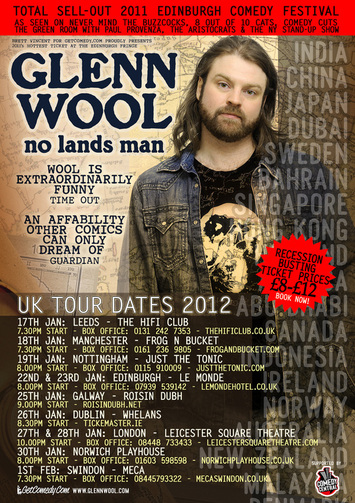
Podcast episode 262ish: Glenn Wool

Better late than never. Here is the much anticipated Glenn Wool episode from ten days ago. It was Glenn's first visit to the show but hopefully not the last. If you watched the YouTube excerpt posted earlier today, you'll know Glenn's voice was... well, Glenn's voice. We talked about it and much more, such as overly sensitive Vancouver audiences, the effects of drugs and alcohol on an aging body, and the soul-destroying nature of auditions.

Have a listen here or go download the episode at iTunes or your podcast server of choice.


The Voice

We're a little behind with the Glenn Wool podcast episode but it's coming soon. Promise. To whet your appetite, he's a little excerpt from that show, complete with accompanying photos. It's almost like being there.


To catch up on the 11 other video snippets, go to the What's So Funny? YouTube channel: http://www.youtube.com/user/guymac22

Sunday, January 15, 2012

Jan. 15: Comedy clips

We are guest-less tonight. But as luck would have it, this week I acquired 15 new comedy CDs. So we'll be hearing from a selection of those. Not sure what I'll draw from yet, but it'll be stuff you haven't heard on the show before. One of them you haven't heard anywhere else before because it's not released to the general public until the end of this month. So you'll definitely be hearing a cut from John Mulaney's new album "New in Town". And for the rest of the hour you'll hear from some of the following:
  • Marc Maron "This Has to be Funny"
  • Michael Ian Black "Very Famous"
  • Mo Mandel "The M-Word"
  • Pete Holmes "Impregnated with Wonder"
  • Doug Benson "Potty Mouth"
  • Tom Papa "Live in New York City"
  • The Beards of Comedy (Andy Sandford, Joe Zimmerman, T.J. Young, Dave Stone) "Cardio Mix"
  • Lewis Black "The Prophet"
  • T.J. Miller "The Extended Play EP"
  • Rachel Feinstein "Thug Tears"
  • Ryan Stout "Touché"
  • Wyatt Cenac "Comedy Person"
  • Carlos Mencia "New Territory"
  • Patton Oswalt "Finest Hour"
If there's something there you really want to hear, let me know somehow. Maybe a comment below, maybe a Tweet to @GuyMacPherson, maybe an email. But remember, show starts at 11.

Saturday, January 14, 2012

World's Biggest Asshole

Now who would that be? I couldn't begin to name one. But Scott Aukerman happily gave us his vote when he visited the What's So Funny? studios back in September of 2009. Run the clip, Kevin:


If you missed it the first time, you can listen to the whole episode here or download it at iTunes.

Tuesday, January 10, 2012

Arj Barker interview

The Snowed In Comedy Tour hits Vancouver this Saturday night so I thought it was a good time to run my interview with Arj Barker. He, along with Craig Campbell, Glenn Wool, Pete Johansson and Dan Quinn will be playing the Granville Island Stage at 8 and 10:30. Don't fret if you're not in town because they are literally coming to a town near you (that is, if you live in BC). Follow the link above to see the full schedule.

ARJ BARKER – December 15, 2011

"Very early on I lost interest in playing the race card so it wasn’t a problem for me that I had to change my name to a more homogenous one. Also, I kept some of the flavour. I mean, Arj isn’t an everyday first name that you hear all the time." – Arj Barker


Guy MacPherson: I saw you here on Granville Island years and years ago. Any idea when that was?

Arj Barker: Yeah, that was a while ago. I’m not very good at remembering dates. So it was a while ago, that’s all I know.


GM: Are you living in Australia now or just part-time?

AB: I’m half and half. I live in California still, too.


GM: So six months of the year in Australia?

AB: Um, yeah, give or take. I like to spend time here.


GM: Do you have a house in Sydney?

AB: No. No, it’s out in the countryside. It’s out in the middle of nowhere, really.


GM: Did you experience culture shock?

AB: No because I started coming out here eleven years ago. I got pretty used to it, you know?


GM: Do you have a family? Or are you a single guy?

AB: Still pretty single. I thought I’d have a family by now but I don’t. I don’t know what happened.


GM: Was it tough leaving your friends or other family?

AB: Yeah, but I get to go back and forth so I sort of have that luxury. And also as a comedian I’m so used to moving around that it’s a perpetual state of leaving people behind and then seeing other people. I never have my friends all in one place anyway.


GM: From what I’ve heard about Australia, the gigs are really far apart. And travelling to other countries is a hassle, too.

AB: Yeah. It’s not too bad. When we do a tour, the average distance is about a one- to three-hour drive. It ranges from one to five hours driving. It’s not too bad, if you don’t mind. I don’t think it’s too bad but I don’t know.


GM: How do you explain your rock stardom in Australia?

AB: Well, I don’t know if I’d go that far, as far as rock stardom. I just got here and kept coming back. I think I got some pretty good television spots early on. Just piled up the television appearances, which really makes a difference, and one day something just shifted and people started to kind of know who I was. I got kind of a good momentum going.


GM: Is there something about your sensibility that strikes a chord with Australians?

AB: Maybe but I don’t try to analyze it too much. I mean, I think I’m pretty funny wherever I go. I think Australia was probably the first country to really say, hey, this guy is pretty good. I feel like this country gave me my props. I don’t think it’s because I have this magical connection specifically with Australia. I think it’s easier to get recognized for something when you appear to be a little more exotic. So it’s like when I came here they probably gave me some free credit just because I was American. I think countries are a little harder on their own.


GM: You were a revelation to me when I first saw you, long before your TV work. So it’s nice to see you get the success I thought you deserved.

AB: Yeah, well, it’s been a relief for me, too, believe me. But I still work in North America. I haven’t given up or anything. I get better crowds than I used to, so that’s good. I always wonder if I go back maybe this time I’ll be completely forgotten about. But I don’t worry too much because I’m already halfway through this thing almost. No point in getting too worked up.


GM: Halfway through what thing?

AB: Life.


GM: Ah. You’re not good with dates, but when did you first play Australia?

AB: Approximately ’99.


GM: Has the Australian comedy scene exploded? Have you noticed a difference since you started going there?

AB: Yeah, I think so because when I first came here I was lucky because there wasn’t a plethora of international comedians out here. A ple-THOR-a. But now there is a plethora of… There’s a lot of guys come out now. It’s definitely become a regular stop on the international comedy circuit with the festival. But when I first came out here there was a handful of Americans that had been here but now I’d say that number is tenfold. I guess I’m saying I got in at a good time.


GM: There even seems to be way more Australian comics.

AB: Yeah, sure. I suppose the scene’s grown. The Comedy Store in Sydney brings in a lot of internationals. It’s still a ways away so a lot of guys haven’t been here.


"It’s surprising how many people say, 'Oh, is [Flight of the Conchords] finished?' It hasn’t had a new episode in probably two years now and people still claim to be fans but they don’t seem to have any idea what’s going on." – Arj Barker


GM: Is part of your success due to The Flight of the Conchords or were you starting to hit before that?

AB: Yeah, that helped but I already had a good foot in the door here big time before that hit. Things had already started to turn pretty well here and then that came. That was another nice little wave to help boost my profile and make a lot of new fans, specifically the cooler, hipper, younger folks who really love that show.


GM: How many seasons did it run?

AB: Only a few, actually. It’s surprising how many people say, “Oh, is that finished?” (laughs) It hasn’t had a new episode in probably two years now and people still claim to be fans but they don’t seem to have any idea what’s going on.


GM: I had mixed feelings about you and Todd Barry on the show. I saw Flight of the Conchords in a club here before they hit it big and I liked them a lot. Then they got the show and I felt like you and Todd should be stars of a show and they should be supporting parts. They were pretty late to the scene and they get their own show.

AB: What happened was they really blew up and generated a huge buzz in Edinburgh one year and from there… In fact, I know the lady who was determined to bring them over to NBC in the States. You must know, also, that there’s really no… One guy can do comedy 20 years and another guy can come along and get his own show in his first year. There’s no rules in this business like that. It’s very flavour-of-the-month, too. But it’s important that, if you have me comment on that at all, I do think they deserve everything they got because they have been doing it a long time before people knew them and they put an extraordinary amount of work into that show from all aspects, from writing it and producing it and writing the songs, recording the songs. I haven’t seen people work much harder than they did and I just think they deserve all the success. I don’t want to take away from that just because I’ve been doing it a long time. I was honoured and privileged to even have a small part on that show. They’re great guys and I can never say nothing negative about them.


GM: Yeah. I wasn’t trying to lead you that way. Like I said, I had mixed feelings because I saw them and thought they were hilarious and that’s the bottom line, that they’re funny.

AB: And as for Todd Barry, he creates his own reality. You can put that in there and hopefully he’ll read it and wonder what the fuck I’m talking about.


GM: Up until a year or so ago, I had no idea you were a Sikh. It really never even entered my mind what ethnicity you were. You don’t talk about it. The idea you had behind your stage name when you started, did you just want to avoid that completely or was it simply a matter of easier to pronounce?

AB: It was purely easier to pronounce. It wasn’t like I was trying to hide my heritage or anything. Although I’ve got one or two jokes about being Indian because when you start out you go, ‘Alright, what am I going to write about? Oh, I’m half Indian, I better write some jokes about 7-11 or something.’ Like that. But very early on I lost interest in playing the race card so it wasn’t a problem for me that I had to change my name to a more homogenous one. Also, I kept some of the flavour. I mean, Arj isn’t an everyday first name that you hear all the time, although I have heard of other people called Arj. So it was purely for pronounciation.


GM: Was Barker from your mother’s side of the family or just a name out of thin air?

AB: I just came up with it.


GM: So you decided you weren’t going to go that route pretty early on, and you don’t begrudge anyone who does. There are a lot of comics who talk about nothing else.

AB: Oh sure, I mean, look at Russell Peters. He’s a billionaire. People love it. I’ll tell you my theory on the whole thing: It’s human nature that you love to hear about yourself. If there’s a conversation at a party and it turns to being about you, not all of us but a lot of us are titillated. It’s exciting, you know? People love being the subject. So when a particular race gets talked about, they’re going to eat it up. That’s why black audiences love urban comics. It cracks them up because when you go there and the subject is about you and your culture, and the same thing Russell Peters is a lot about Indians and their culture and Asians, and that’s exciting and makes you feel celebrated. You want to laugh and you feel like you’re part of it. It’s a great thing for guys that do it. It works well. It’s done a lot. If you go to New York it seems like the majority of the comics are race-based. But I’m going to tell you right now, and I’ll go on the record: it bores the shit out of me, personally, to make observations about different cultures based on race. Although, having said that, I’ve made a lot of jokes about Australian culture and I’ve carved out a living, practically, talking about that. Although that’s not my whole show. But personally I’m not judging those guys that do that. I don’t consider myself an authority on what people should talk about or how they should do their show. It’s just me personally, I just like jokes. Just purely from my own personal taste, it bores me to do race-related jokes.


GM: Do you think it’s easier or cheating?

AB: I don’t think it’s my place to say. Comedy is not easy. Original comedy is definitely not easy. There’s hack jokes, but there’s also hack jokes about airplanes, there’s hack jokes about race. It’s just not for me personally. And I don’t feel like I’m an authority to tell other comedians what they should do. Clearly it works and people love it. That’s my point. Russell’s a friend of mine. Not like a close, tight pal that I talk to all the time, but we’re colleagues and I’ve known him for quite a while. It works great for him. I’m happy for him. And of course I wish I’d done it now (laughs). I’d be in a castle. But I do find it quite dull, personally, to talk about race because I think that for me, personally, I would like to break down racial barriers and speak to audiences as a group of humans. I also don’t overthink it too much. I don’t know, I just didn’t go that direction with my comedy.


GM: Do other Sikhs come to you and say you should be talking about them?

AB: No. No, not at all. I get some Indians at my shows but not in droves. Occasionally I think people come because they find out I have Indian heritage, but not really, no. My heritage hasn’t been a big part of my world view.


GM: A lot of those comics end up being spokesmen for their race. And you’re just a comic.

AB: Yeah, I’m just a comic. But probably a big part of it, too, is I grew up in northern California in a mostly white population. There was the odd Asian kid kicking around and a couple black guys and me. But it wasn’t like a big issue. It was very liberal, at least not outwardly racist. There’s always some racism that’s well-hidden, but generally it was a pretty liberal quote-unquote open-minded area so it just wasn’t an issue. I didn’t grow up only going to Indian functions or anything like that. I had Indian relatives around but I also never wanted to sell out jokes about my grandfather, you know? That didn’t appeal to me. In my first year of comedy, before I understood that you had a choice… When you first start, you do pretty much anything to get a laugh. You don’t think ‘I’m not a guitar comic’ or ‘I don’t do parodies’; you just think ‘fuck, that’ll get a laugh, let’s do it.’ Then I think you become more refined as to what you want to do. In my first year I had a joke that my dad worked in 7-11, to give you an idea. I don’t need to do the joke. The point is very early on I did [that kind of material]. I find this whole subject kinda dull so maybe we can move on. I’m just not an ethnic comic. I don’t do ethnic comedy. It bores me. That’s all I have to say.


GM: Have you always played it straight-faced in life?

AB: I think I’ve always been a bit dry, if that’s what you’re asking. Yeah, definitely. I think that’s just a natural component of me.


GM: Last time you were here you played a big theatre. The first time I saw you, you were in a smaller theatre. You’re playing bigger theatres now. Do you prefer that, or do you miss the intimacy of a smaller room?

AB: I can have fun in both. It really depends on the crowd and the vibe. There’s a lot of variables but I can certainly have a great time at any size gig. Sometimes performing for thousands of people at a time – when I performed with Flight of the Conchords it was at places like the Hollywood Bowl and Wembley Arena – it’s pretty exciting but it definitely lost something because there’s so many people there. But between playing to a hundred people and a couple thousand, I can certainly have a great time, regardless of size. That’s not a big issue. There’s a joy of playing to lots of people and also just playing in a café with 20 people and no mic. That can be one of the funnest gigs. That’s sometimes where I feel like I’m at my funniest. You can’t underestimate how important intimacy is with the crowd. I don’t even know where I’m playing this time so I’m just going to have a fun tour.

Podcast episode 261ish: Dylan Rhymer

Dylan Rhymer became the first guest of this leap year, 2012, when he dropped by the What's So Funny? studios on January 1st. He also helped set a record for the longest episode in series history at 1 hour 18 minutes 22 seconds, beating out the last episode of 2011 featuring Harry Doupe, who clocked in at an already impressive 1 hour 16 minutes 7 seconds. (For the record, third place goes to Larry Miller at 1 hour 10 minutes 52 seconds.)

But it's not about time, it's about content. And there's never a shortage of topics to talk about when Dylan's around. We discussed old-timey radio, religiosity, bike lanes, parliamentary assholes, public breastfeeding, North Korea and more.

So here you go. Have at 'er. Click and listen. Or download at iTunes. Your call.


Sunday, January 8, 2012

Jan. 8: Glenn Wool

I don't know how I missed Glenn Wool back in 1995 but I did. He started out his stand-up comedy career here in Vancouver and performed around town (I'm assuming) until he up and moved to England, where he lived for the next decade-plus. I was around in town from '95-98, but our paths never crossed. I wasn't writing about comedy on a regular basis then, but I was surely going out to shows, albeit not as frequently. It's a shame because it's always interesting to witness career arcs, watch comics progress and evolve. All I know is what I've seen since he already established himself as one of the top stand-ups in the UK and, hence, the English-speaking world. He's not nearly as well-known on this side of the Atlantic as he should be. Not even here in BC, where he's from. But all that's about to change with tonight's visit to What's So Funny?, the long-running star-making radio show/podcast... or not. But at least you'll get to know more about Wool than you knew before.

He was supposed to join us last year but had to cancel due to blowing out his voice at the Vogue Theatre the night before. Here's hoping he spent the day gargling hot tea and honey and sipping Listerene. He's going to need his voice not only for our show, but check out that UK tour he's got coming up starting next week. Told ya he was big over there.

As usual, we're on the air from 11 pm PST to midnight on CFRO, 102.7 FM, in Vancouver or livestream us at coopradio.org.

Friday, January 6, 2012

Demetri Martin interview

Demetri Martin is playing Vancouver Saturday. I spoke with him a few weeks ago. My story on him ran in the Straight last week. Below is the full transcript of our chat. I just want to explain my first substantial question, though. In the bio I was sent by the publicist – a bio clearly written by Martin – the last line reads, "Demetri has brown hair and he is allergic to peanuts." I hope that clears things up.

Demetri Martin
December 7, 2011

"I tend to gravitate to jokes. I like puzzles, I like the puzzle of writing a joke. I like trying to get an idea down to just a few words. And it’s fun to tell jokes. Sometimes I’m not that interested both in my own personal stuff and someone else’s. They have to be really good at it. I call it the who-gives-a-shit? test. Who gives a shit, you know?" – Demetri Martin

Guy MacPherson: How are you?

Demetri Martin: Good. I’m sorry. I was supposed to call you 2 o’clock my time. I messed up. Sorry about that.


GM: That’s alright. You in L.A?

DM: Yeah.


GM: I see in your bio that you have brown hair.

DM: Yes.


GM: How has that affected your comedy?

DM: Well, I present a little more ethnic probably than the average comedian. So I think I like to offset that with non-ethnic material so I wouldn’t get pigeon-holed. So far so good.


GM: That’s good. Yeah, I haven’t heard you talk about your brown hair in other interviews. So I thought maybe I’d get the scoop. I did hear you on WTF with Marc Maron. It’s no knock on you that I don’t remember it but I remember loving it. And the reason I don’t remember is because I’ve listened to all of them and they tend to blend in with each other. Were you happy with it? Do you feel you revealed too much?

DM: Nah, I thought it was fine. The only reactions I got were from other comedians who were friends: “Hey, I heard you on there. Good job.” You know, I’ve known Marc a long time. I wrote my first book so I thought, cool, I’ll go on there to promote my book and maybe he’ll plug my book. So when I went on it was when the book first came out. But then he didn’t release it until months later so that didn’t help me very much. But it was cool to be on his podcast. Plus I’m allergic to cats. I was just starting to get symptoms towards the end of the interview. But I was fine.


GM: You went to law school. I know there are some comics who’ve left lofty or noble professions to pursue comedy and everyone thinks they made the right choice. Do you think you’d do more good as a lawyer or a comic?

DM: Oh, I don’t know if I do any good. Neither. I discovered that focusing on how I spent each day helped me feel fulfilled. Helping people, working with kids, with juvenile rights, legal aid: these were options in law school to pursue. But the problem was when I doing the actual activities – going to law school, going to class. I wasn’t enjoying it. I didn’t want to have dread in my life. I thought I have to come up with something other than dread. For me that was one of those pivotal life moments. I remember literally asking myself, How do I want to spend my time here? What do I look forward to? And then which of those things could be a job? Comedy was a pretty good contender because I like joking around with my friends. And I was in New York. And there were comedy clubs. Two of them at the time – one of them across the street from my law school and the other half a block down. So I thought, alright, I’m going to try this. That was my way in. The idea of doing good or anything, that was already off the table when I was having the survival debate with myself.


GM: It could be argued, and it is argued, that comedians do do good. It’s cathartic to laugh, it makes people feel better.

DM: Yeah, I think so. I think whatever your career is, you figure out the point where your relationship with the larger community is: donating to foundations, doing charity shows, that kind of thing. There must be a way to leave at least a more positive influence.


GM: You’re touring Canada. Why Canada, why now?

DM: I haven’t been there in a while. The reason now is because I’m gonna do a stand-up special in February, filmed in New York. And I haven’t filmed one of those in six years by the time we shoot it. Five or six years. So I wanted to do a tour where I get ready for it. I have a bunch of new material and I haven’t been to Canada in a while. In fact, I haven’t been to Edmonton or Calgary. I’ve never been to those two places. I don’t think I’ve performed in Ottawa. I’ve performed in Vancouver, I’ve performed in Montreal and I’ve performed in Toronto.


GM: You still use your guitar, right?

DM: Yeah, I use the guitar. Sometimes I play the keyboard. I think on this tour I’m just going to play the guitar. You know, I have a lot of bits that don’t have any instruments or any drawings. When I started that’s mostly what I did: I told jokes. So it’s fun because I improvise more than I used to and I play around during the show more than I used to to keep it pretty loose and not have so many things on stage. Because what happens is if I have the keyboard there and the guitar and all this stuff and then I want to improvise and the show just goes in a different direction I still feel obligated to go do stuff on the keyboard, but then it makes the show kinda long. I mean, it’s not like it’s that much time but sometimes just knowing that it’s there it can be a speed bump.


"God, there are so many things that people get mad about in comedy. It’s so funny that people waste so much energy getting all mad." – Demetri Martin


GM: It amazes me that some comics, among certain other comics, still get flack for using an instrument. Do you ever get it?

DM: I guess, I don’t know. A few years ago I stopped Googling myself and that was a good decision. I don’t hang out on the scene so much. I have a lot of friends in comedy… It’s funny. Being in the mix in New York you go to all the alternative rooms and hang out with all the comedians all the time. But I’m sure I get flack for a few different things.


GM: I’ve never heard flack about you using it. Just in general.

DM: Yeah, most comics don’t like song parodies, don’t like prop comics. God, there are so many things that people get mad about in comedy. It’s so funny that people waste so much energy getting all mad. I mean, when people steal material I think that’s a serious problem. That’s bad. But other than that…


GM: Now there’s a trend towards making comedy so personal. But you basically do jokes, one-liners.

DM: I do jokes, yeah. I’ve done a few one-man shows over the years that were personal. They were personal stories. Very personal. I tend to gravitate to jokes. I like puzzles, I like the puzzle of writing a joke. I like trying to get an idea down to just a few words. And it’s fun to tell jokes. I like personal stuff. I like comedians who do it, but I think sometimes I’m not that interested both in my own personal stuff and someone else’s. They have to be really good at it. I call it the who-gives-a-shit? test. Who gives a shit, you know? I mean, if you’re really good and you’re charismatic… Louis’s really good at it. I think Louis’s a good example. He’s very funny and literate, creative and honest. You know, someone like that. I think Bill Cosby’s always great at It. Richard Pryor. I think it’s just another form and you gotta figure out if that works for you. When I did the one-person shows, I enjoyed it. It was fun. It’s a different way of connecting with the audience. But I do still like jokes. It’s kind of what I started with.


GM: Is it true you did a 500-word palindrome?

DM: Yeah, in the book I just wrote in a chapter called Palindromes for Specific Occasions. The last of the palindromes in there was 500 words.


GM: Wow. How long did that take you?

DM: It took a while. That was something I wrote a bit of a while ago. I can’t remember why. Years ago I wrote this other one that was 224 words long so I remember at some point thinking it would be cool to write one that’s longer than that. I don’t really have a reason to do that; there’s no application. But I travel a lot so sitting on a plane I’ll just write a little bit here and there. And then when I got the book deal I thought, ‘Oh, I’ll put a palindrome in the book.’ So I wrote the book mostly the summer before last. I had a deadline so I sat down and started writing a lot of stuff for it. While I was writing over the summer I would go back to the palindrome and say, ‘If I can get this done in time, I’ll put it in the book.’ But maybe it totalled a couple of weeks.


GM: Are you good at anagrams, too?

DM: I used to be pretty good at anagrams. It’s funny. Before I did stand-up I was more interested in things like anagrams and puzzles. I would do puzzle books. But I think one of the reasons I did end up as more of a joke writer is because what I found in comedy was the same kind of satisfaction. Just playing with ideas like that. Perception. There’s a game to it that I really like. It kind of satiated a lot of that need for me. I don’t spend as much time doing puzzles and stuff. If I want to do that, I sit down and try to write a short story or write a joke or something.


GM: You don’t Google yourself so maybe you haven’t seen this, but on Wikipedia it says you do something called paraprosdokians. Do you know what that is?

DM: No.


GM: It’s apparently a type of statement where the ending makes you reinterpret the beginning.

DM: Hmm. Interesting. Probably a lot of jokes are like that.


GM: I asked my Facebook friends if they had any questions for you. So I have a few here.

DM: Cool.


GM: “I’d like to know how his parents felt about him dropping out of law school. And how they feel about his decision now” – although I know your father’s deceased – “And where the courage came for him to drop out of a secure career to pursue his dream of comedy (and we are thankful he did).”

DM: Oh, that’s nice. I think when I dropped out, when I decided to pursue comedy that was the first time in my life pretty much everybody who I was close to disapproved of my choice or was disappointed. And I never realized how much I had people’s approval until that point. That didn’t feel good at the time but it also was really liberating because I realized, Oh, I disappointed people and that wasn’t so bad. I feel free! I can be a poet, I can be a dancer or I can be a painter. They’re already disappointed so I’m in the clear. So that was pretty nice. So what started as kind of a negative became a legitimate, positive thing for me. And then over the years a kind of weird thing happened with my family where when I started a lot of aunts and uncles and those kinds of people were – I don’t know what the word is; I wouldn’t say judgmental as much as they thought it was funny, like ‘oh, ha-ha. Good luck.’ And then I did well enough where I make a living and then all of a sudden it’s like, ‘oh, he thinks he’s a hot-shot.’ I never really had, like, ‘Hey, we’re proud of you.’ Or, ‘Wow, you did it. Good job.’ So it just went from making fun of me to some of them resenting me, like, ‘Oh, Mr. Hollywood. Excuse us.’ (laughs) What?! Okay. So again it was kind of like learning the same lesson, which was I guess I’m better off if I don’t care too much about what other people think is good for me and I’ll have to just follow my own way. And as far as any courage goes, I think I was more trying to avoid despair. I realized quickly that for me personally following through on a career in law might lead to a feeling of despair. Not because it’s such a terrible career, but for me it didn’t feel like a good use of what my mind naturally does, where it naturally goes each day. It was almost like fighting it to do something that was kind of more role-based and linear, and I like more meandering thinking.


GM: Another question comes from a Canadian comic. He says, “Levi MacDougall is one of his go-to guys both as a show writer and opening act. Is it true he found him on the internet? Does he still search the same way?”

DM: Yes, Levi’s going to be touring with me on this tour. And yeah, when I was staffing my show for the second season I went and tried to do research and find comedians I hadn’t heard of, find sketch actors online. I don’t spend a lot of time looking for comedy online. I’ve seen a lot of comedy since 1997, when I started. And while I love comedy, I like to do other things. I like to read books and go see music shows and watch movies and whatever else people do. So I don’t go home each night and go, ‘Oh geez, I want to watch comedy.’ But when I was casting the show I was really curious to see who’s out there and who have I not heard of. I know a lot of the folks coming out of New York and I know a bunch of people in L.A. but where are there other people? And without realizing it, I found a good number of comics from Canada. You know, I just click on a video and think it was funny. There were two guys I hired from Canada: Nate Fielder and Levi MacDougall. And both I discovered for myself through the internet. But I haven’t done that in a while. At this point I’m not staffing anything so I’m not really looking around for stuff. But I imagine if I get another show or something, I’d probably do the same. It was cool getting to know Levi and Nathan, talking to those guys about comedy and Canada specifically. They were saying that there just aren’t as many comedy development opportunities where they were in Toronto as there are, say, in Los Angeles, outside of stand-up. For, like, getting a television series. I said to them I really liked a lot of the videos I saw, and people seemed like they were making content where they weren’t so worried about selling to a wide audience. That doesn’t mean it couldn’t be enjoyed by a wider audience, but it didn’t seem like some of the stuff I see in the States where people are trying to get a million hits on the internet and they want to get famous or something. And they said, “No, that’s probably true. We were making stuff for the crowd that comes to, say, the Rivoli,” where they performed a lot in Toronto. You know, for each other. “Because we’re not thinking, ‘Oh, I’m going to get discovered and I’ll have my own series on the Comedy Network.” And it’s cool because, as frustrating as that is for a lot of the talent in Canada, when you’re an outsider looking at it, what you see is just stuff that is original and funny and seems unconcerned with broad tastes or something. Which is a lot of the stuff I love.


GM: Another one: “My question to Demetri is about when he talked about MySpace on the Daily Show and he mentioned he was friends with Sparkle Bunny. Did he mean my Sparkle Bunny character? Because she sent him a message and he never responded. At that time I was the only Sparkle Bunny on MySpace and I wonder if he just made up that name.”

DM: Wow! Good question. (chuckles) I’m wracking my brain as you were reading it! Um, okay, there are two answers that are possible. One, I made up the name because it sounded like it would work in the bit. Sparkle Bunny sounds like an interesting name. And two, I thought I made it up but I had maybe looked through, just from looking at friends’ names it was in my subconscious or something. But I don’t remember picking out Sparkle Bunny and being like, ‘Oh yeah, I’ll put this in.’ And then as far as the message, the follow-up, I tried pretty quickly not to look at messages on MySpace or respond to people because I don’t know who people are. It’s just too weird, I think. If someone friends you and they know who you are and what you look like, you’re this person, and you don’t know anything about them. It’s really asymmetrical. It’s really kind of weird. You actually have a lot less power, I think, as a human being in that relationship.


GM: These days, though, celebrities and athletes are interacting with these strangers through Twitter and through Facebook.

DM: Yeah, I haven’t figured out how to do that. I like putting content out there but I don’t want to get ensnared.


GM: Next one: “Ask him if he’s upset that Zach got the career that Demetri was supposed to have.”

DM: Uh, no. I guess if Zach and I looked a lot alike or something. I don’t picture myself in a lot of those roles that Zach does. I think he’s well-cast. It’s his thing. It’s funny, I’ve never wanted anyone else’s career. I’m friends with Zach. I think he’s really funny. He does really well at what he does. But I want to make my own films. I want to write and direct my own movies. Whoever else writes and directs their own movies, I don’t see movies and think ‘I wanted to make that.’ It’s such a specific, subjective business. So I think I can honestly say there’s nobody who has the career that I want. I love the kind of career let’s say Woody Allen has had. But I mean he’s Woody Allen. What’s interesting there is it’s about being prolific than about being in this movie or that movie. So I’m still trying to learn how to do that.


GM: Did you watch that documentary on Woody Allen?

DM: Yeah, I did. I enjoyed it.


GM: Have you ever met Steven Wright?

DM: Yeah, I met him a few times. He was really cool. Friendly and gracious and surprisingly warm. I see him on stage and think maybe he’s going to be floating out there but it was really cool. He was real friendly and he knew me. He was like, ‘You’re the guy with the drawings, right?’ I said, ‘Right.’ He said, ‘Oh yeah, those are great.’ So I was thrilled.


GM: Last one from Facebook: “Can you ask him where the emergency stop key to my treadmill is. My kid hid it and now can’t find it and I’m getting more and more out of shape by the second. Thanks.”

DM: Yes. It’s in the kitchen. It’s in one of the cabinets; one of the lower cabinets.


GM: Okay, great. I’ll pass that along.

DM: Thanks for taking time.

Legends – Bill Reiter

It's been a few weeks since I last did a video snippet. So here's one for you. If you haven't had the chance to listen to the episode with the legendary Bill Reiter from last May, see if this doesn't whet your whistle.

Sunday, January 1, 2012

Jan. 1: Alistair Cook & Dylan Rhymer

Damn, if it isn't 2012. I have no idea how that happened. I remember as a kid figuring out how old I'd be in the year 2000 and it seemed like a million years in the future. Now it's already 2012? Krazy.

We're starting the new year off running. It's a holiday but not for us. We've got twos this week to make up for missing a show on Christmas day. Tonight Alistair Cook (if you're of a certain vintage, that name will ring a bell but it's not the Masterpiece Theatre AC; he's the hip bizarro world AC as seen on the right) and Dylan Rhymer (above left) join us to talk about East Van comedy in general and the Blackout Broadcast in particular. Tomorrow's a holiday so you can stay up. We're on the air at 11, or shortly thereafter. Have a listen.

THIS JUST IN: As you can see by the cross-outs, Alistair Cook is unable to join us tonight. Does Stop Podcasting Yourself employ a Helen Kushnick-like booker who won't allow their recent guests to do our show? Yeah, let's start that rumour.